Personal & Family: Giving Your Life Its Own Corner of the Vault
Your vault isn't only for the things you build. Here's how I gave my family its own walled section — and the one rule that keeps your worlds from leaking into each other.
Most of what my AI does for me now isn’t work.
It’s “what should I make this week,” answered from what my family actually eats — not a generic meal plan, ours. It’s “plan us three days somewhere,” answered from how we actually travel. It’s “help me think this through for one of the kids,” and it already knows which kid and what they’re into. The vault — the same plain-files memory I’ve spent three editions building — turned out to be most useful the day I stopped pointing it only at my projects and pointed it at my actual life.
New here? This builds on three earlier pieces — Edition 1: The Foundation (the structure), Edition 2: Fill the Vault (filling it), and Edition 3: Use It Anywhere (using it in any tool). This one extends all of it to your life. It also stands on its own.
Giving your life its own section
I gave my family their own section of the vault. The meals we actually cook (and the one ingredient quietly banned at the table because half the house can’t stand the smell of it). How we travel — planned, not improvised, because one of us genuinely doesn’t like surprises. The kids’ school context. The trips we’ve got coming. Stable facts about the people I live with.
It’s the same move as every other edition — write down the durable context once, in plain files you own, so you stop re-explaining it — just pointed at home instead of work. And it pays off the same way, every day: the assistant stops asking me to reconstruct my own household before it can help.
The question you should be asking
If you’ve read the earlier editions, a small alarm might be going off — the same one I planted in Edition 1. If the things I build and my family are both in this one system… can the side I use for one reach into the other?
Good. That’s the most important question in the whole series, and it’s the reason this edition exists. The honest answer: it’s only a problem if you build it carelessly — and the fix is simpler than people expect.
The fix is a boundary — here’s the actual mechanic
When I added the family section, I didn’t just drop it in a folder next to my projects. I gave it its own scope with a rule written into it. If you’ve followed along, you already know the shape of this: every scope in the vault has a short instruction file at its root that any AI reads first — the orientation file from Edition 1 (the CLAUDE.md / AGENTS.md idea). That file is where the boundary lives.
The pattern, stated plainly:
- The family scope’s instruction file says, in effect: you’re working in the family context; read this scope and the shared basics — do not read the project scopes.
- Each project scope’s file says the mirror image: read this project and the shared basics — do not reach into the family scope.
- A small shared, neutral base sits underneath both — the genuinely cross-cutting basics (your name, your timezone, the essentials) — and both sides may read it.
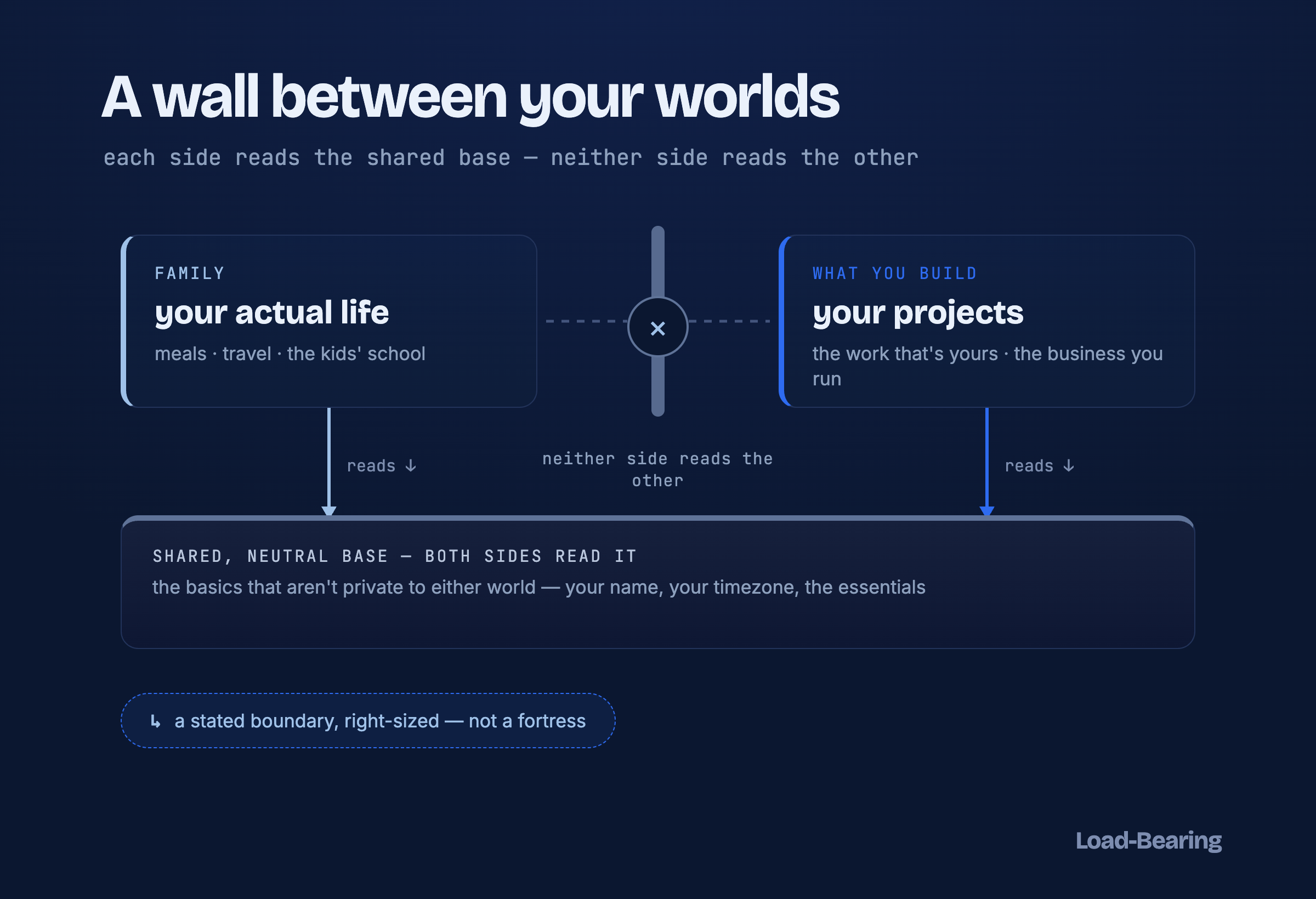
Two scopes, one wall, a shared base both can read — the whole boundary in one picture.
That’s the whole thing. No database, no permissions system, no second machine. The boundary is a sentence that every agent reads on the way in and respects. Each world can see the shared base; neither can see into the other’s private corner.
Right-sizing the wall (the part most people skip)
I want to be precise about what that boundary is, because overclaiming would be its own kind of dishonesty.
On a machine only I use, the real risk isn’t an attacker breaking in. It’s me — my own contexts bleeding into each other: an assistant working on a project casually pulling in something personal because it was sitting right there, or a family request reaching into project notes that should’ve stayed separate. Once you name the threat honestly, it tells you how much wall to build. A stated rule the agent reads and follows is exactly enough for that threat. A hardened sandbox would be solving a problem I don’t have.
So this is a stated boundary, not a fortress — and that’s not a compromise, it’s the right-sized answer. (The architecture-altitude version of this — what changes when you want the boundary enforced, not just stated — is a story for much later in the series. Here, the stated boundary is the point.)
The same question, everywhere
That distinction — should the AI working on one thing be able to see a different thing? — turns out to be the most useful security question almost anyone can ask. The founder keeping the company’s books out of a personal chat. The freelancer juggling two rival projects. The person whose side venture shouldn’t bleed into the family calendar. Same question every time. Usually the answer is no, and usually nobody’s drawn the line — not because it’s hard, but because nobody told them it was a line they could draw.
Where this leaves you
If you’ve followed the series this far, you now have the whole wide arc in hand: a memory you own, filled with your real knowledge, usable in any tool, and extended to your actual life with a boundary that keeps your worlds apart. That’s a complete, genuinely useful thing. If this is where you get off, you got full value — go build yours.
But you might have noticed what I noticed: I keep saying I told it once, I load the slice, I keep the worlds apart — and all of that is still me, doing it by hand. Everything from here goes to the deep end — what I built on top of all this so the loading and the walling happen for me, and why I built my own instead of buying one.
The worksheet
For this edition, the resource is the one I wish I’d had: a worksheet that interviews you and builds your own family vault, with the keep-it-separate boundary baked in. I built mine first and ran the questions on my own household before I’d hand them to anyone. Subscribe and reply “send it” and it’s yours — it’s in the library next to the structure kit, the loader, and the cheat-sheet.
If you keep one thing from the wide half of this series, keep this: the AI doesn’t care whether your knowledge is for work or for dinner. You decide what it’s allowed to see. The system just does what you told it — which is the whole point of owning it.